
Concrete Driveways in Pendleton, Indiana
Pendleton Concrete Works installs and replaces concrete driveways for homeowners throughout Pendleton and the surrounding area. We build every driveway to handle Indiana's freeze-thaw winters and years of daily use without cracking or crumbling.
25+
Years of Experience
400+
Concrete Projects Completed
4.9 ★
Average Google Rating
Understanding Your Concrete Driveway
A concrete driveway is one of the most heavily used surfaces on your entire property. Unlike a patio or sidewalk, it carries the daily weight of one or more vehicles, often multiple times a day, while also standing up to direct sun exposure, heavy rain, road salt, and Indiana's harsh freezing winters year after year. Few surfaces on a home work this hard, which is exactly why proper installation matters so much.
Homeowners typically need a new driveway when their existing one has become cracked, sunken, or was simply installed decades ago using older techniques that don't hold up to modern expectations or today's vehicle weights. Some driveways were never built with a proper base to begin with, which means problems were essentially inevitable from day one. A properly installed driveway does more than just look good. It improves curb appeal and adds real, measurable value to your home, while eliminating the safety hazards, water pooling, and constant patch-and-repair cycle that comes with deteriorating concrete. For most homeowners, a new driveway is also one of the most noticeable upgrades a property can receive, since it's the first thing anyone sees when pulling up to your home.
When It's Time to Replace Your Driveway
Most homeowners start seriously considering a driveway replacement when they notice widespread cracking, chunks of concrete breaking away near the garage or street, or entire sections that have visibly sunk or shifted out of alignment with the rest of the slab. Driveways that were installed without a properly compacted gravel base are especially prone to these issues over time, since the soil underneath naturally shifts with seasonal moisture changes, and concrete poured directly on unstable ground has nothing solid to rest on as that movement happens.
Standing water is another major warning sign. If you're noticing puddles pooling in low spots after every rain, especially near the garage door or along the edges of the driveway, this usually means the slab has settled unevenly and is no longer draining the way it should. Left alone, that pooling water accelerates erosion of the soil underneath even further, compounding the settling problem season after season. Likewise, if your driveway has become uneven enough that you notice a real lip or step between sections when walking or driving over it, that's a clear sign the underlying structure has failed, not something a surface patch will meaningfully fix.
Putting off a driveway replacement typically doesn't make the problem go away. It just gives it more time to get worse. Each Indiana winter introduces dozens of freeze-thaw cycles that widen existing cracks and create brand new ones in previously sound concrete, while the daily weight of vehicles continues accelerating structural failure in already weakened sections. What might be a moderate, affordable repair cost today often turns into a full, far more expensive replacement if the underlying issues are left unaddressed for another year or two.
How We Build a Driveway That Lasts
We begin every driveway project with full excavation, removing the old concrete entirely along with any unstable or eroded soil underneath, down to a solid, dependable subgrade. This step alone makes a significant difference in how long the new driveway will last, since building on a weak or uneven base essentially guarantees future problems, regardless of how well the concrete itself is poured.
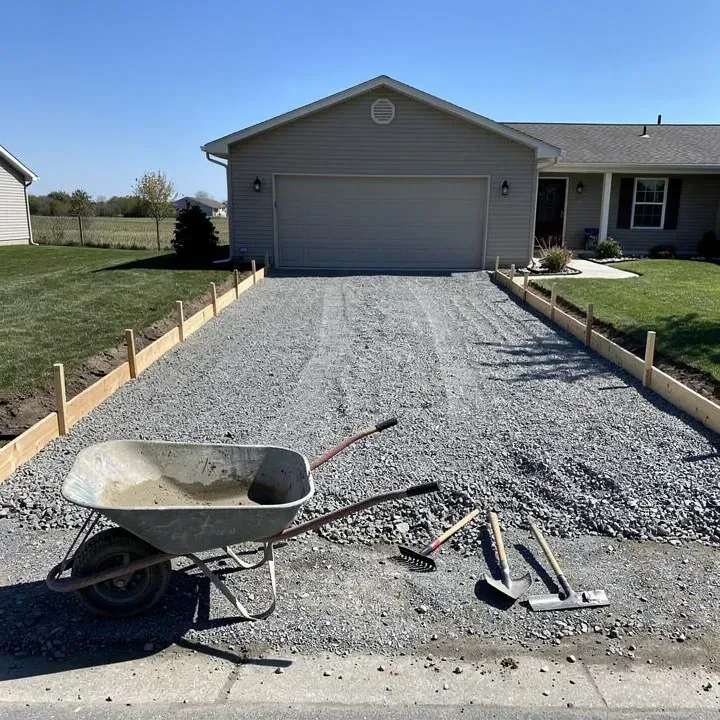
From there, we install and properly compact a gravel base, sizing it specifically to handle Indiana's clay-heavy soil and the seasonal moisture swings common in our area. This is, without question, the single most important factor in the long-term performance of your new driveway, and it's also the step that's easiest for a less experienced or corner-cutting contractor to rush or skip altogether.
Once the base is properly set and compacted, we form the driveway to the correct dimensions, thickness, and slope, making sure water is directed away from your garage and home rather than pooling near the foundation or threshold. We then pour air-entrained concrete, a mix specifically formulated with microscopic air pockets that give freezing water room to expand without cracking the surrounding material, and finish the surface with a broom texture designed for safe, reliable, non-slip traction even when wet. Control joints are placed at carefully calculated intervals throughout the slab, so that if cracking ever does occur down the road, it happens in a controlled, barely noticeable way rather than randomly across the surface. After the pour is complete, we allow the concrete proper curing time before opening the driveway up to vehicle traffic, since rushing this final step is one of the most common and avoidable causes of premature damage.
Understanding Driveway Pricing
Several distinct factors come together to determine the total cost of a driveway project, and understanding them helps explain why two seemingly similar driveways might come with very different price tags. The size and shape of the driveway is the most obvious factor, since more square footage naturally means more material, more labor hours, and more time on site. Irregular shapes or driveways with curves and multiple sections can also add complexity compared to a simple rectangular layout.
Site accessibility plays a meaningful role as well. Driveways that require extensive demolition of old concrete, removal of large trees or roots, or significant grading work to correct drainage issues will understandably cost more than a straightforward replacement on an already level, easily accessible lot. The condition of the existing soil also matters here, since poor or unstable soil sometimes requires additional excavation and base material to achieve a stable result.
The type of finish you choose for the surface is another major factor. A standard broom finish remains the most economical option for most homeowners and performs excellently for daily driveway use. Decorative finishes, such as stamped concrete patterns or exposed aggregate, add real visual appeal and can make a driveway feel like a true design feature rather than just a functional surface, but they come with a higher cost due to the additional labor, specialized tools, and extra time required to achieve those finishes properly.
Finally, the thickness and reinforcement of the slab itself affects pricing, and this isn't something we standardize across every project. We determine the appropriate thickness and whether additional reinforcement like rebar or wire mesh is needed based on expected vehicle weight, soil conditions, and how the driveway will actually be used. We provide a detailed, itemized quote upfront for every project, so you know exactly what you're paying for, and why, before any work begins on your property.
Frequently Asked Questions
How long does a driveway replacement take from start to finish?
Most residential driveway replacements take between 2 to 4 days, depending on the size of the driveway and whether old concrete needs to be removed first. This typically breaks down into one day for demolition and excavation, one day for base preparation and forming, one day for the actual pour, and additional curing time before the driveway is ready for vehicle traffic. Larger or more complex driveways, such as those with decorative finishes or extensive drainage corrections, can take a bit longer. Weather can also extend this timeline, since rain or extreme temperatures right before or after a pour can require us to delay slightly for the best possible long-term result rather than rush a pour under poor conditions.
Can I park on my new driveway right away?
No, new concrete needs time to gain enough strength before it can safely handle vehicle weight. We generally recommend waiting at least 7 days before driving regular vehicles on a new driveway, and longer, sometimes two full weeks, before parking particularly heavy vehicles like RVs, boats, or loaded trailers on the surface. Walking on the new concrete is typically fine after 24 to 48 hours, but actual driving requires significantly more curing time. We'll always give you a specific, realistic timeline for your project based on the exact weather conditions during your pour, since temperature and humidity affect curing speed.
Do you remove and dispose of my old driveway?
Yes, full removal and disposal of your existing driveway is included as a standard part of our replacement process. We break up the old concrete, haul it away, and properly dispose of it, so you don't need to arrange any separate demolition or hauling services on your own. This is factored into your upfront quote, so there are no surprise fees added once the project gets underway.
What's the difference between a standard and a decorative driveway finish?
A standard broom finish provides a clean, textured, reliably non-slip surface and remains the most cost-effective option for the vast majority of homeowners, performing excellently under daily driveway use and Indiana's seasonal weather. Decorative options, like stamped concrete patterns or exposed aggregate finishes, add genuine visual interest and curb appeal by mimicking the look of natural stone, brick, or other premium materials at a fraction of their cost, but they come with a higher price tag due to the additional labor, specialized tooling, and extra time required to execute those finishes correctly. We're happy to bring samples and walk you through pricing for both standard and decorative options during your free, no-obligation quote, so you can decide what fits both your budget and your vision for the property.
Your Concrete Project Starts With One Call
Don't let a cracked sidewalk, sinking patio, or unfinished project linger another season. Contact Pendleton Concrete Works today for a free quote, and let our 25+ years of experience take the stress out of getting your concrete fixed or built right.


Contact
(765) 703-8469
Mon–Sat: 6am–7pm
Pendleton, IN
About Us
Pendleton Concrete Works is a locally owned and operated contractor with over 25 years of experience serving homeowners throughout Pendleton and the surrounding area. We're built on honest pricing, quality craftsmanship, and a commitment to standing behind every project we complete. Proudly serving Pendleton and the greater Madison County area.
© Copyright 2026 Pendleton Concrete Works. All rights reserved.
© Copyright 2026 Pendleton Concrete Works.
All rights reserved.